
What Makes AI character chat Different From Normal Chatbots?
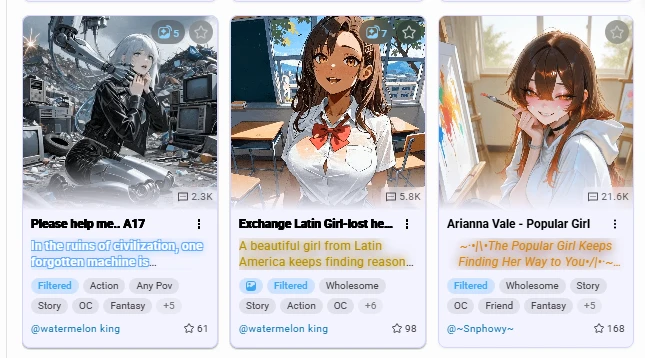
AI character chat differs from normal chatbots because it is designed around personality, memory, and emotional interaction rather than only answering questions. Traditional chatbots focus on task completion, while AI character systems combine large language models, character profiles, and memory features to create continuous conversations. By 2025, consumer AI companion platforms had reached millions of users worldwide, showing that people increasingly seek interactive digital personalities instead of simple information tools.
Artificial intelligence chat technology has developed through several stages. Early chatbot systems from the 1960s, such as ELIZA, mainly used pattern matching to simulate conversations. Modern systems use large language models trained on billions of text samples, allowing them to generate context-aware responses. A normal chatbot usually follows a service-based structure: identify the question, retrieve information, and provide an answer. AI character chat adds another layer by maintaining a consistent identity, tone, and conversational history.
The difference starts with the purpose of interaction. A customer support chatbot from a company may answer thousands of users with similar responses because consistency and efficiency matter most. An AI character is created to feel unique. It may have a fictional background, specific personality traits, preferences, and communication habits.
“A chatbot gives information. A character creates a relationship around information.”
This design approach has changed how users interact with AI. A 2024 survey of digital companion users reported that many people valued personality and conversational continuity more than pure factual accuracy. Around 60% of users in several AI companion studies mentioned that remembering previous conversations improved their overall experience.
The second difference is long-term memory. Traditional chatbots often operate within one session. If a user asks about a previous conversation days later, the system may not have access to earlier details. AI character platforms increasingly include memory databases that store selected user preferences, conversation history, and character-specific information.
For example, a normal chatbot may respond:
“Here are five books about psychology.”
An AI character may respond:
“You previously mentioned enjoying behavioral science topics. I think these three books may match your interests better.”
Memory changes the structure of communication because each conversation becomes connected. Developers use retrieval systems and user profiles to improve personalization while limiting unnecessary data storage. In 2025, memory-based AI systems became a common feature across many consumer AI applications.
Personality consistency creates another difference between the two systems. A standard chatbot does not need a stable personality because users mainly care about completing a task. AI characters need predictable behavior because users interact with them as recognizable digital identities.
Character design usually includes:
| Element | Normal Chatbot | AI Character Chat |
|---|---|---|
| Response style | Neutral and practical | Personality-based |
| Conversation goal | Solve requests | Maintain interaction |
| Memory | Limited session history | Long-term preferences |
| Creativity | Restricted by purpose | Open-ended storytelling |
| User relationship | Service provider | Digital character |
The technology behind personality management combines prompt design, model fine-tuning, and behavioral guidelines. A character may be instructed to speak casually, use humor, provide emotional support, or maintain a specific fictional role. Consistency across thousands of conversations is one of the main technical challenges for AI character systems.
Emotional response is another area where AI character chat differs from ordinary chatbot services. Traditional systems usually identify keywords and provide predefined assistance. AI character platforms analyze conversation context, sentence patterns, and previous interactions to generate responses that match the user's emotional state.
A user saying “I had a difficult day” may receive a standard chatbot reply:
“I can provide information about stress management.”
An AI character may reply:
“That sounds exhausting. Do you want to talk about what happened today?”
The AI does not experience emotions, but it can generate language patterns associated with empathy and social communication. Research on human-computer interaction has shown that conversational style influences user engagement. A 2023 study involving more than 1,000 participants found that users rated personalized conversational agents higher in perceived friendliness compared with purely functional systems.
The difference also appears in entertainment and creative applications. Normal chatbots are generally limited to answering questions, while AI character systems support role-playing, storytelling, and interactive scenarios. Users can create fictional companions, game characters, or educational partners.
For example, a history chatbot can explain information about ancient civilizations. An AI character can act as a historical figure and discuss events through a role-based conversation. A language-learning chatbot can provide vocabulary exercises, while an AI character can simulate daily conversations with different speaking styles.
Creative interaction has become one of the fastest-growing uses of character AI. Platforms focused on fictional conversations, romance simulation, and adult-oriented interactions have attracted significant attention, including applications related to ai sexting, where users interact with AI-generated characters in private conversations. These systems rely on the same technologies used in other character platforms, including language generation, personality settings, and conversation memory.
Voice and visual technologies have expanded these differences further. Modern AI character applications increasingly combine text models with speech synthesis, facial animation, and digital avatars. According to industry reports from 2024, multimodal AI applications grew rapidly as users preferred conversations that included voice, images, and interactive expressions rather than text alone.
A normal chatbot usually exists inside a website or customer service window. AI characters can appear as virtual people with names, voices, and visual identities. This creates a more immersive communication style, especially in gaming, education, and entertainment.
However, AI character chat also faces technical and social challenges. Maintaining personality consistency requires large amounts of computing resources and careful system design. A character that changes behavior randomly may reduce user trust. Memory features also require privacy controls because personal conversation records can contain sensitive information.
The comparison between normal chatbots and AI character chat can be summarized as follows:
| Category | Normal Chatbots | AI Character Chat |
|---|---|---|
| Main function | Information and assistance | Conversation and interaction |
| Design focus | Accuracy and speed | Personality and continuity |
| Typical users | Customers and employees | Individuals seeking engagement |
| Content style | Direct answers | Narrative conversations |
| Development goal | Task efficiency | Social simulation |
The growth of AI character chat reflects a broader change in how people use artificial intelligence. In 2020, many AI systems were mainly adopted for workplace automation and customer support. By 2025, consumer applications showed stronger demand for personalized interactions, creative collaboration, and digital companionship.
AI character chat is different from normal chatbots because it treats conversation as an experience rather than only a service. The technology still depends on the same foundation of artificial intelligence, but personality design, memory systems, and emotional communication create a different type of interaction. As language models continue improving, AI characters will likely become more common in entertainment, education, gaming, and personal communication.