
Red Flags a Trained Brand Team Catches Before the First Sample Arrives
Red flags in fragrance sourcing rarely look like dishonesty. They look like a fast answer to a complicated question, a sample pack with no information attached, a quotation that covers three things and assumes seven, and a brief that comes back interpreted in a way nobody asked for. A brand team that has been through even a short perfumery programme reads those signals early, because it knows what a competent answer contains and can hear the difference between confidence and vagueness. For a founder building a direct-to-consumer brand, catching them at the quotation stage is the cheapest decision available.
Key takeaways
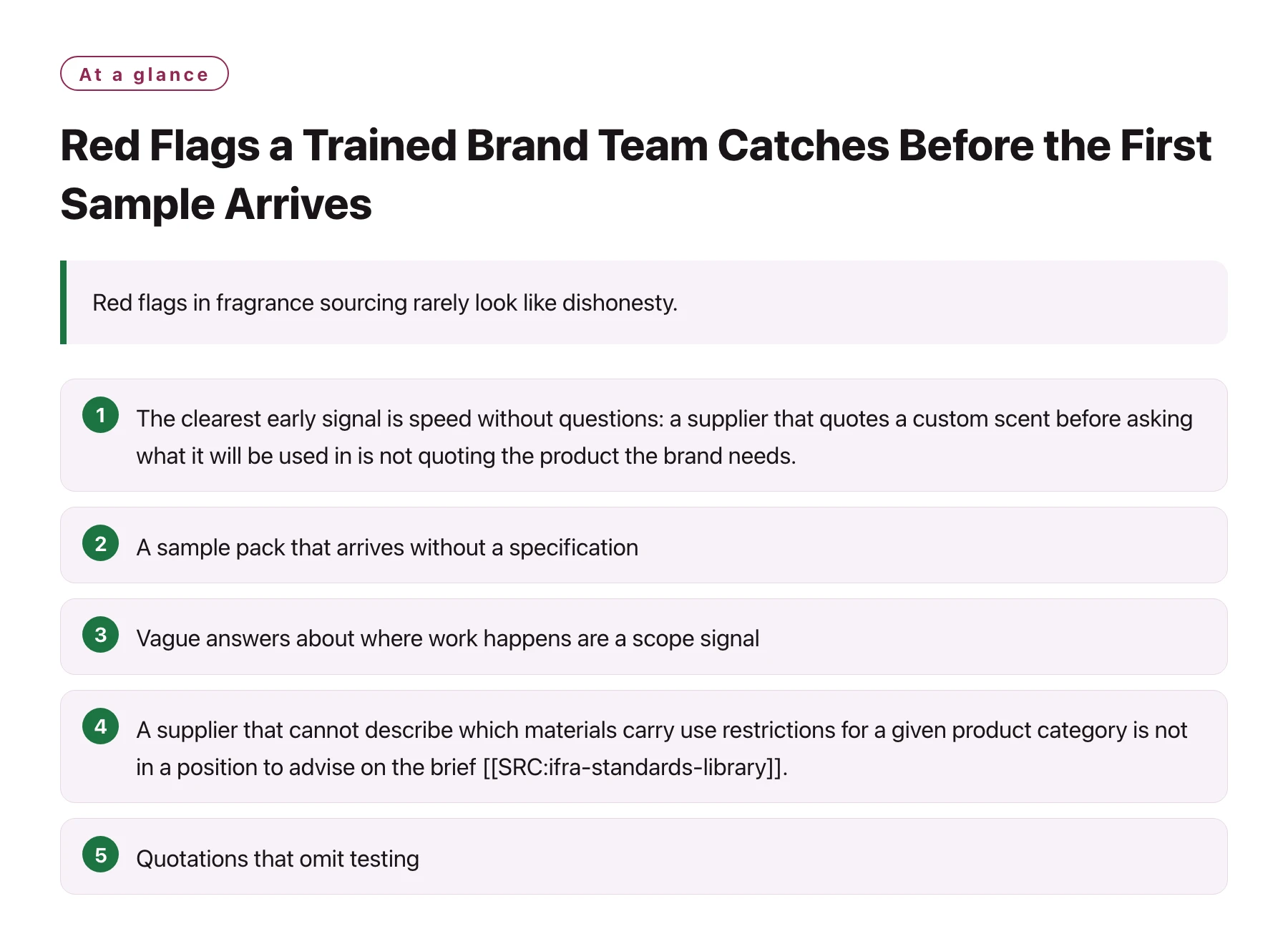
- The clearest early signal is speed without questions: a supplier that quotes a custom scent before asking what it will be used in is not quoting the product the brand needs.
- A sample pack that arrives without a specification, a dilution note or a version number is a documentation problem showing itself before any money changes hands.
- Vague answers about where work happens are a scope signal, because the brand cannot manage quality across processes it cannot see.
- A supplier that cannot describe which materials carry use restrictions for a given product category is not in a position to advise on the brief [1].
- Quotations that omit testing, tooling, decoration or documentation are not cheaper; they are a price for a smaller scope than the brand assumes.
- Pressure to commit to a volume before a sample round usually reflects the supplier's commercial need rather than the brand's best interest.
A founder building a direct-to-consumer fragrance brand is doing two things at once: learning an unfamiliar process and judging a business partner. That combination makes people overlook signals they would catch instantly in their own industry, particularly when a supplier is enthusiastic, responsive and cheap.
The reassuring thing is that the signals described below are all available before a deposit is paid. They appear in correspondence, in the structure of a quotation, in the questions a supplier asks, and in what arrives in the post. None of them requires a factory visit, a laboratory or a technical background, and the only skill involved is knowing what a good answer looks like.
Read together, these patterns are also a useful way to compare two suppliers who both seem competent.
Signals in the conversation
The opening exchange tells a founder more than the brochure does. A supplier that will quote a custom development without knowing the product format, the target market, the price point or the intended volume is guessing, and a guess that is later corrected becomes a renegotiation. Good suppliers ask an inconvenient number of questions, and they ask them before they talk about price.
It is worth noticing which questions are asked as well as how many. A supplier that only asks about volume and packaging is thinking about the order. One that also asks what the scent must do in use, which references the brand likes, and which markets it will be sold in is thinking about the product, and those are the answers that make a first sample usable.
Answers that are fast but empty
Speed is pleasant and often mistaken for competence. The tell is whether the fast answer contains specifics: a material suggestion, a category qualification, a mention of a testing route, a named constraint. An answer that arrives in ten minutes and contains only encouragement has not answered anything, and the same vagueness will appear later when a batch needs to be justified.
A related pattern is the answer that reframes the question. Asked whether a formula is suitable for a leave-on body product, a weak supplier replies that it is very popular with other clients. That is a different question answered fluently.
Scope described in adjectives
When a supplier describes its service as full, complete or one-stop without naming the steps, the brand cannot tell where its responsibility ends. The remedy is simple and revealing: ask for the process as a numbered list, from brief to delivered pallet, with a note against each step saying whether it happens in-house. Suppliers that manage the process can produce that list from memory; suppliers that assemble projects from partners tend to produce a paragraph instead.
Where the work genuinely is subcontracted, that is not automatically disqualifying, but the brand needs to know which parts and who holds the quality records for them. A frank answer builds confidence; an evasive one does the opposite.
Signals in the quotation and the sample pack
A quotation is a specification in disguise. The line items reveal what the supplier believes it is selling, and the omissions reveal what it expects the brand to arrange. Development rounds, testing, tooling for decoration, printing plates, filling, cartons and documentation are the usual absences. When several are missing, the quote is not a bargain; it is a partial quote, and the remaining cost will arrive later without the benefit of comparison.
Sample packs carry the same information. A professional pack identifies each direction, states the version or date, gives the format and the concentration, and often includes a short note on the intent and the materials used. A pack of unlabelled vials with a message saying which one the supplier likes best removes the possibility of a structured comparison, which makes it harder for the founder to keep control of the decision.
When technical questions meet deflection
Sooner or later a founder asks a technical question, and the response at that moment is informative. Fragrance materials carry use limits that depend on the product category, so a formula comfortable in a fine fragrance may need adjustment in a body lotion or an air freshener. A supplier that can say which materials are limited, in which categories, and how much headroom the candidate has, is demonstrating a working safety process [1]. A supplier that answers that everything is compliant without qualification is either assuming a category the brand did not specify or has not checked.
The same test works with testing. Asking which product-and-package combinations would be tested, and who signs the resulting report, produces a specific answer from a functioning quality process and a general reassurance from a weak one.
Commercial pressure as a signal
Fragrance manufacturing has real seasonal congestion, so a supplier may genuinely need notice before a slot is available. That is different from urgency designed to compress the brand's decision. If a company cannot hold a quotation open for a reasonable review period, or if the only quoted price depends on committing to volume before a sample round, the incentive to skip diligence is being manufactured rather than discovered.
A useful habit is to ask what happens if the first order is smaller than the indicated volume, and to ask it in writing. The answer describes the supplier's real minimum and its real flexibility, which is far more informative than whatever number appears in the price column [2].
None of these signals is proof of bad faith, and a founder should resist treating a single awkward answer as a verdict. What matters is the pattern across the whole first exchange: questions asked, specifics offered, scope named, documents offered, and pressure applied. A supplier can be forgiven a slow reply far more easily than a vague one, because vagueness at the quotation stage becomes vagueness at the bulk stage, where it costs the entire order. It is also worth remembering that the assessment runs both ways: a brand that arrives with a clear brief, a defined market and a written question set is treated as a serious buyer, and the better manufacturers respond accordingly. The company behind a candidate does have a public face worth reading before the first call, and comparing the company behind the factory with what its representatives say in writing is a fifteen-minute exercise that often settles whether the second call is worth having. Founders who want to see what a structured diligence process looks like from the brand side can also review due diligence on a perfume manufacturer, which sets out the same signals in checklist form. The same set of tests applies to every candidate a founder shortlists, including Guangzhou Xuelei, and the value of running them in the same order with the same questions is that two suppliers finally become comparable on the things that actually predict a working relationship.
Sources
- IFRA Standards Library (International Fragrance Association) —— The IFRA Standards Library lists the restrictions the fragrance industry applies to individual fragrance ingredients, based on safety assessments; it is the reference point for compliant fragrance formulation.
- Cosmetics Business —— A trade publication covering the beauty and cosmetics industry, including fragrance launches and regulatory developments.
Frequently asked questions
What is the biggest red flag when choosing a fragrance supplier?
A specific answer given without asking the questions that answer depends on. If a supplier quotes a custom scent without knowing the product format, the market and the volume, the number is a placeholder, and the process behind it is likely to be similarly improvised.
Is a low quotation a warning sign?
Not by itself, but a quotation that is low because it covers less scope is. Compare line items rather than totals: development rounds, testing, tooling, decoration, filling, packaging and documentation should either appear in the quote or be explicitly excluded in writing.
Should we walk away from a supplier that subcontracts some steps?
Not automatically. Subcontracting is normal in packaging and decoration, and sometimes in filling. The question is whether the supplier names which steps are outsourced, holds the quality records for them and takes responsibility for the result. Evasion about outsourcing is the red flag, not the practice itself.
How many suppliers should a first-time founder contact?
Enough to compare, usually two or three, with the same brief and the same written question set. More than that spreads attention without improving the decision, and the comparison only works if every supplier answers the same questions in the same format.
What should be in a sample pack?
Each direction labelled with an identifier and a date, the format and concentration stated, and a short note on the intent and the materials. That structure allows a blind comparison against the brief. Vials without identifiers make it impossible to score the directions fairly or to refer back to one later.